Setting Up an AI Governance Committee Before Your Organization Adopts Clinical AI
4 min read An AI governance committee is a cross-functional group that decides which clinical AI tools a healthcare organization adopts, how…
Read More
A Joxel Group Thought Leadership Perspective
Every behavioral health clinician recognizes the moment. A client shares a breakthrough, reveals a long-held fear, or discusses a crisis they have never experienced before. The conversation reaches a critical therapeutic point, and the clinician’s attention is pulled away. Eye contact breaks. Hands move to a keyboard. The focus shifts from human connection to documentation.
The interruption may seem minor, but its impact is significant. Clinical documentation remains one of the most persistent challenges in behavioral health and human services. Industry estimates suggest clinicians spend 30–40 percent of their workday documenting services, completing assessments, updating treatment plans, and satisfying regulatory requirements. Time devoted to documentation is time unavailable for direct client engagement, care coordination, professional development, or recovery from the emotional demands of clinical work.
In behavioral health, where the relationship itself is often the primary intervention, this tradeoff carries meaningful consequences. Every moment spent focused on a screen rather than a client can reduce engagement, diminish therapeutic presence, and contribute to clinician fatigue.
This reality raises an important question:
What if the clinical conversation itself became the foundation of documentation?
What if the natural exchange between clinician and client captured appropriately, governed responsibly, and supported by modern technology could serve as the primary source of EHR documentation, reducing the dependence on traditional form-based data entry?
Increasingly, that possibility is becoming reality.
Voice-enabled documentation, supported by advances in artificial intelligence (AI), speech recognition, and natural language processing (NLP), is evolving from an emerging technology into a practical workflow strategy. Organizations that understand both its opportunities and its limitations will be best positioned to realize its benefits.
To appreciate the significance of voice-enabled workflows, it is important to acknowledge how clinical documentation functions in many behavioral health environments today.
Modern EHR platforms such as Netsmart myAvatar and myEvolv provide robust capabilities for treatment planning, service documentation, billing, reporting, and compliance management. Yet despite their sophistication, the core documentation experience remains heavily dependent on forms, dropdown selections, structured fields, and narrative text boxes.
This approach exists for valid reasons. Structured documentation supports regulatory reporting, reimbursement requirements, quality measurement, and population health analysis.
However, the operational reality often creates unintended consequences.
Clinicians must continually shift between active listening and data entry. This constant cognitive switching disrupts the therapeutic process and can affect both the quality of client engagement and the accuracy of documentation.
Many documentation workflows are designed around the needs of the EHR rather than the realities of clinical practice. As a result, rich clinical observations and nuanced therapeutic interactions are frequently compressed into predefined formats that inadequately reflect the complexity of care.
Documentation requirements are consistently cited as a leading contributor to clinician burnout. The widespread practice of completing notes after hours is not evidence of workforce dedication is a symptom of workflow inefficiency.
When documentation becomes burdensome, clinicians often feel pressure to complete notes quickly. This can result in incomplete records, inaccuracies, excessive reliance on copied-forward content, and inconsistent documentation quality all of which create potential compliance and audit concerns.
The issue is not the existence of structured documentation. The issue is that structured documentation has become the dominant interface between clinicians and the EHR, despite the emergence of technologies that can support more natural and efficient alternatives.
Voice-enabled documentation represents a fundamental shift in how information enters the clinical record.
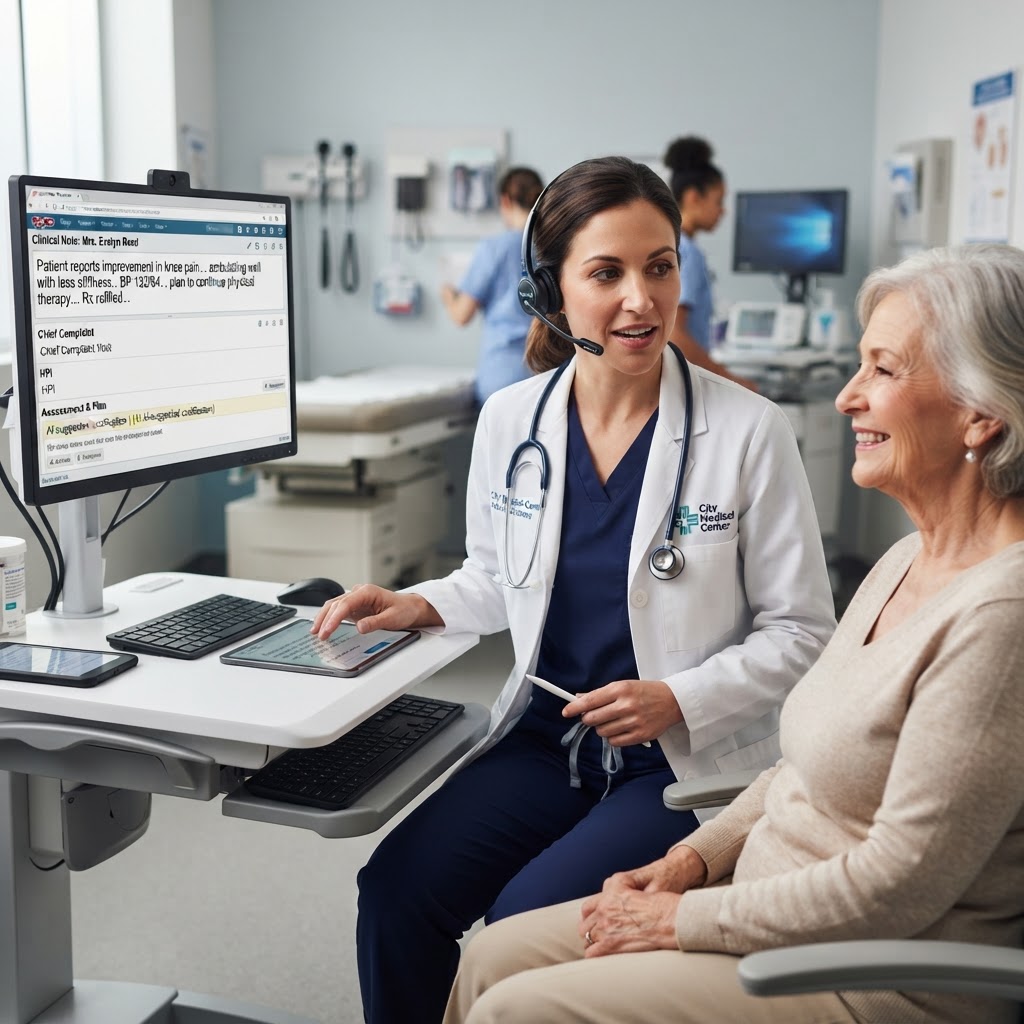
Rather than requiring clinicians to translate conversations into forms during or after an appointment, clinical dialogue becomes the primary source of information, with technology performing the work of transcription, organization, and structuring.
Modern speech-to-text platforms have achieved a level of accuracy that supports clinical use cases. Clinicians can verbally document encounters during designated portions of care or immediately afterward, allowing narratives to be captured naturally and efficiently.
Beyond simple transcription, NLP technologies can identify key clinical concepts and automatically map them to relevant EHR fields. Diagnoses, treatment goals, interventions, risk indicators, service types, and progress measures can be extracted and structured without requiring extensive manual entry.
Building upon transcription and NLP, AI can generate first-draft documentation, including progress notes, treatment plan updates, authorization narratives, and discharge summaries.
This transforms the clinician’s role from primary author to reviewer and approver, significantly reducing the effort required to produce high-quality documentation while maintaining clinical ownership.
Voice interfaces can also simplify navigation and workflow execution. Clinicians may be able to retrieve records, review treatment plans, document service delivery, or update workflow statuses through voice commands without interrupting the flow of client engagement.
Voice-enabled workflows have implications across healthcare, but their potential impact is particularly significant within behavioral health and human services.
Unlike many medical specialties that rely heavily on physical examinations, laboratory results, or diagnostic imaging, behavioral health care generates its primary data through dialogue.
The traditional workflow of conducting a therapeutic conversation and then manually translating that conversation into documentation, introduces an unnecessary intermediary step. Voice-enabled documentation helps eliminate that inefficiency.
Behavioral health care depends on context, observation, reflection, and clinical reasoning. While structured data remains important for compliance and reporting, the narrative often contains the most meaningful clinical insights.
Voice-driven workflows preserve that narrative richness while enabling technology to manage the structured elements required by the EHR.
Behavioral health organizations continue to face significant workforce shortages and recruitment challenges.
Reducing documentation burden is not merely an operational improvement, it is a workforce retention strategy. Clinicians who spend more time practicing and less time documenting are more likely to experience greater job satisfaction and remain engaged in their organizations.
Clients notice when clinicians divide their attention between conversation and documentation. They notice interruptions. They notice reduced eye contact. They notice when technology becomes the center of interaction.
Voice-enabled approaches support greater clinician presence, helping create a more engaged, attentive, and therapeutic environment. In trauma-informed settings, where trust, safety, and connection are foundational, this can directly enhance the quality of care.
While the potential benefits are compelling, successful implementation requires careful planning and disciplined governance.
One of the most common misconceptions is that voice-driven documentation requires continuous recording of therapy sessions.
In practice, the most effective implementations are intentionally designed workflows in which clinicians capture documentation-relevant content at specific points during or after the session. Organizations must carefully evaluate consent requirements, privacy considerations, and clinical appropriateness before considering ambient recording approaches.
AI-generated documentation should never be viewed as final documentation.
The clinician remains the author of record and is responsible for reviewing, editing, and approving all documentation before it becomes part of the legal health record. Governance frameworks must ensure that clinical review remains mandatory and meaningful.
The use of voice technologies introduces additional considerations regarding data collection, processing, retention, and security.
Organizations must establish clear policies governing:
The shift from keyboard input to voice input does not reduce regulatory obligations, it heightens the need for disciplined governance.
Voice-enabled workflows should not eliminate structured documentation requirements. Billing, reimbursement, regulatory reporting, quality measurement, and outcome tracking continue to depend on accurately coded and structured information. Success depends on technology’s ability to reliably convert natural language into structured clinical data.
Technology alone will not solve documentation challenges. The most successful implementations focus on workflow redesign, clinician experience, training, supervision models, compliance processes, and change management. Organizations that treat voice-enabled documentation as a technology initiative rather than an operational transformation will struggle to achieve sustainable adoption.
Behavioral health organizations considering voice-enabled documentation should pursue a structured, phased approach.
Organizations should begin by identifying the documentation processes that create the greatest burden, such as:
At the same time, leadership should evaluate EHR integration capabilities, compliance requirements, organizational readiness, and clinician perspectives. Early clinician engagement is critical. The individuals who use the workflow must help design it.
A pilot should include a representative group of clinicians and a clearly defined measurement framework. Key metrics may include:
Governance controls including consent processes, audit capabilities, review requirements, and retention policies, should be established before deployment.
Organizations should expand only after demonstrating measurable value and refining workflows based on real-world experience. Long-term success requires:
Voice-enabled documentation should be viewed as an evolving capability rather than a one-time implementation.
Over nearly two decades of advising behavioral health and human services organizations on EHR strategy, implementation, optimization, and transformation, including extensive work with Netsmart myAvatar and myEvolv, we have observed a consistent trend:
Technology has advanced dramatically, but documentation workflows have not evolved at the same pace. Voice-enabled documentation presents a meaningful opportunity to close that gap. Done correctly, it allows clinicians to focus on what they do best, engaging with clients, applying clinical judgment, and delivering care, while technology manages the administrative tasks of capturing, structuring, and organizing information.
However, organizations should approach this transition with realistic expectations. Voice technology is not a standalone solution. Success requires thoughtful governance, workflow redesign, clinician engagement, compliance oversight, and strong leadership.
At The Joxel Group, we help organizations evaluate emerging technologies through a strategic lens, ensuring that investments support clinical outcomes, operational efficiency, workforce sustainability, and regulatory compliance.
Because the goal is not simply better technology but rather in creating an environment where clinicians can remain fully present with their clients while maintaining the documentation standards that quality care demands.
The future of clinical documentation is unlikely to be defined by faster typing or better templates. It will be defined by technologies that remove administrative friction, preserve the integrity of the therapeutic relationship, and allow clinicians to spend more time where they create the greatest value with the people they serve.
Voice-enabled EHR workflows represent one of the most promising opportunities to achieve that vision. The organizations that succeed will not be those that implement technology the fastest. They will be the organizations that thoughtfully redesign workflows, establish strong governance, engage their clinicians, and keep client care at the center of every decision.
Guiding Change. Delivering Value.
The Joxel Group partners with behavioral health and human-services organizations to optimize EHR platforms, strengthen technology strategy, improve operational performance, and prepare for emerging innovations such as AI-enabled clinical workflows. Learn more about our strategic advisory, EHR optimization, and digital transformation services at The Joxel Group.

4 min read An AI governance committee is a cross-functional group that decides which clinical AI tools a healthcare organization adopts, how…
Read More
6 min read Understanding the total cost of ownership (TCO) for EHR systems is crucial for healthcare organizations aiming to make informed…
Read More6 min read Understanding EHR Implementation: A Comprehensive Guide for Healthcare Organizations In the rapidly evolving landscape of healthcare, the integration of…
Read MoreJoxel offers experienced, expert assistance throughout every phase of your journey. Reach out to start the conversation.