Setting Up an AI Governance Committee Before Your Organization Adopts Clinical AI
4 min read An AI governance committee is a cross-functional group that decides which clinical AI tools a healthcare organization adopts, how…
Read More
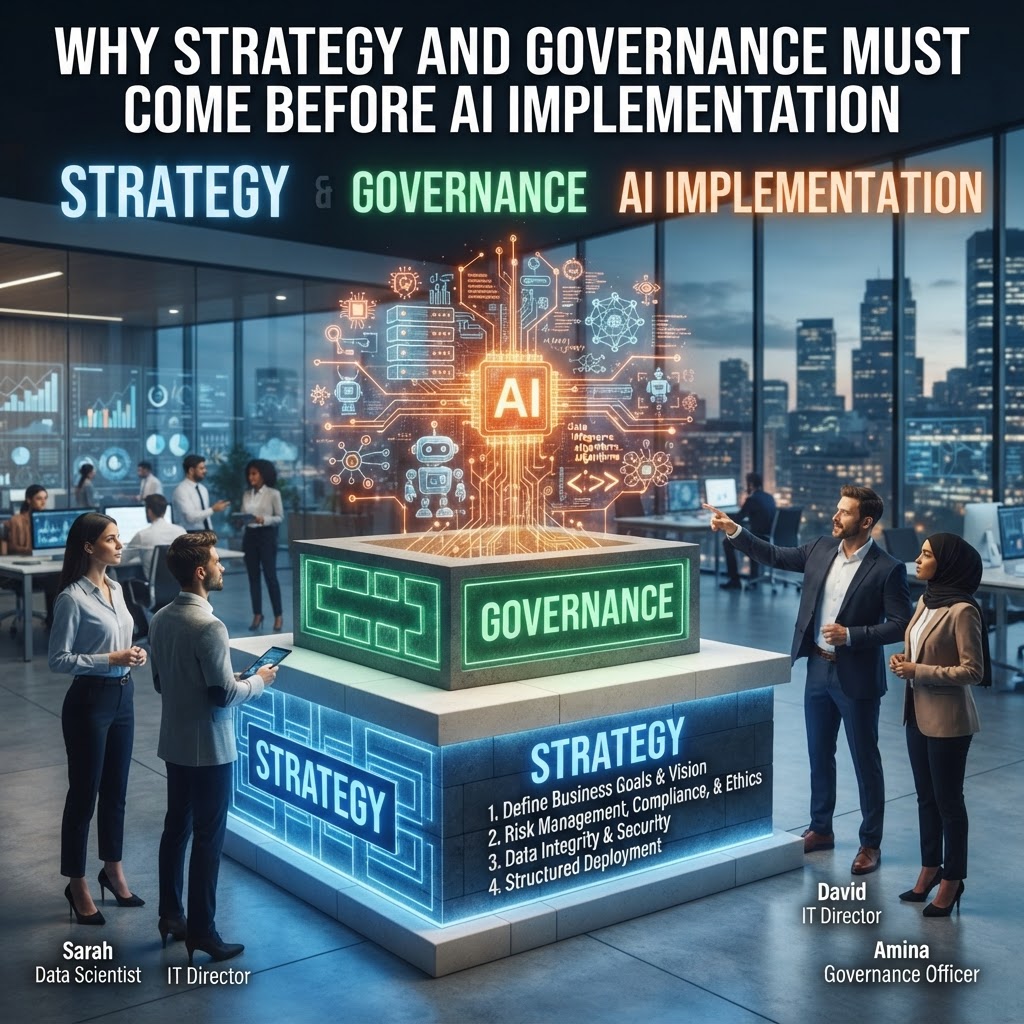
Artificial intelligence is no longer a futuristic concept for healthcare and public-sector organizations, it’s here, and the pressure to adopt is real. Integrated vendor demos and compelling ROI projections paint a picture for behavioral health providers that AI will transform clinical documentation, and that public pension systems will be streamlined by integrating predictive analytics and automated member services.
After nearly two decades of helping organizations navigate complex enterprise software, here’s what we’ve learned: even the most advanced technology delivers little value when the foundational strategy and governance are not in place.
Before a single line of code is written or a single model is deployed, organizations must conduct a rigorous review of their strategic alignment and governance readiness. Skipping this step isn’t just risky in healthcare and public-sector environments, it’s irresponsible.
We’ve seen this before, when EHR adoption surged, cloud migration became non-negotiable and “data interoperability” became the buzzword of the moment. Organizations rushed in, bought the software, and then spent years and hundreds/millions undoing decisions made without sufficient strategic grounding.
AI implementation follows the same arc, but the stakes are higher. AI doesn’t just store or move data, it makes decisions, generates content, and influences clinical and operational outcomes. Without a strategy that clearly defines why you’re adopting AI, what problems it should solve, and how it aligns with your mission, you’re not implementing technology, you’re introducing risk.
A pre-implementation strategy review forces your organization to answer questions that vendor demos conveniently skip:
A strategy review also surfaces a critical question many organizations overlook: should we even be doing this right now? Sometimes the honest answer is that foundational optimization better workflows, cleaner data, stronger governance needs to come first. That’s not a setback, that’s leadership.
If strategy answers what and why, governance answers who, how, and what if. In healthcare and public-sector contexts, governance isn’t bureaucratic overhead it’s the safeguard that stands between innovation and liability.
What do you do when an AI-generated recommendation contradicts a clinician’s judgment? Who is responsible when an automated claims denial is wrong? Who audits the model for bias? If your organization can’t answer these questions before implementation, you’re not ready.
Governance frameworks must define:
Healthcare organizations are guided by HIPAA, 42 CFR Part 2, and a growing patchwork of state and federal AI regulations. Public pension systems guided by sunshine laws, fiduciary responsibilities, and public-records requirements. AI implementations that don’t account for these guidance frameworks from day one are ticking time bombs for compliance.
A governance review ensures that data privacy, consent management, audit logging, and regulatory reporting are designed into the solution instead of considered only after a problem surfaces.
AI models can perpetuate and amplify existing disparities. In behavioral health, this could mean under-detecting risk in certain populations. In public pensions, it could mean disparate service quality across member demographics. A governance framework that includes ongoing bias auditing, diverse stakeholder input, and equity benchmarks isn’t optional, but a moral and operational necessity.
Organizations that bypass strategy and governance reviews before AI implementation consistently experience:
The cost of a thorough strategy and governance review is a fraction of the cost of a failed AI initiative. In healthcare and public-service environments especially, the cost of failure isn’t just financial, it’s human.
At The Joxel Group, we’ve spent years helping healthcare organizations and public pension systems navigate the selection, implementation, and optimization of complex enterprise software. We bring that same disciplined, relationship-driven approach to AI readiness.
Our process is customized for your unique needs. Therefore, instead of selling you a technology roadmap, we start by helping you address the hard questions via:
We believe in utilizing AI in solving difficult problems with the care, accountability, and integrity your mission demands.
AI deployment generates data, influences workflows, and creates precedents, regardless of whether the deployment is a pilot or large-scale. Since the decisions will be affecting real people in real time, retrofitting accountability is far harder than designing it in. For this reason, we feel that proactively establishing governance is better than doing so reactively.
It involves a structured assessment of your organizational goals, current data and technology landscape, regulatory obligations, stakeholder needs, and risk tolerance. Based on this, we create a clear framework that defines use cases, decision rights, compliance protocols, success metrics, and implementation guardrails before we perform any pilots.
It varies by organization size and complexity, but a meaningful strategy and governance review typically spans two to four weeks based on organization availability.
Absolutely. In fact, smaller organizations often face greater risk because they may lack dedicated compliance and IT governance staff. A structured review is even more critical when internal resources are limited, ensuring that AI investments are purposeful, compliant, and sustainable from the start.
AI introduces unique dimensions that traditional IT governance doesn’t fully address model drift, algorithmic bias, explainability requirements, and autonomous decision-making. AI governance requires specialized frameworks that account for these factors in addition to traditional concerns like data security, vendor management, and project oversight.
Guiding Change. Delivering Value.
Interested in understanding how AI can advance your organization’s mission while strengthening governance, accountability, and strategic alignment?
The Joxel Group helps healthcare and public-sector organizations adopt AI responsibly through strategic advisory services focused on readiness, governance, and long-term value creation. Learn more by visiting https://thejoxelgroup.com.

4 min read An AI governance committee is a cross-functional group that decides which clinical AI tools a healthcare organization adopts, how…
Read More
6 min read Understanding the total cost of ownership (TCO) for EHR systems is crucial for healthcare organizations aiming to make informed…
Read More6 min read Understanding EHR Implementation: A Comprehensive Guide for Healthcare Organizations In the rapidly evolving landscape of healthcare, the integration of…
Read MoreJoxel offers experienced, expert assistance throughout every phase of your journey. Reach out to start the conversation.